Showing posts with label Tombstone. Show all posts

Sunday, December 14, 2014

Mining for Authentic Details

Lorna Kerin Beall
In the children’s novel I’m writing, The Wormy Bean Winter, Kata’s Finnish Pappa and her thirteen-year-old brother, Jari, go to work in a Copper Mine in Butte, Montana.
Vanadium, Colorado mine, ca 1900. Western History/Genealogy Dept., Denver Public Library.

I needed to find out if they used Carbide helmet-lamps there in 1919. So I called a librarian in Butte and, surprise of surprises, she’d seen a photograph of a miner wearing one for the very first time in that mine in 1912!  She also explained in detail how the carbide “lumps” worked. I owe her many thanks.
I also needed to know the name and description of the contraption (elevator?) the miners took to enter the mine. My daughter (who had done some research for her own screenplay) hooked me up with Carey Granger, the tour guide and care-taker of the Good Enough Silver Mine in Tombstone, Arizona. Carey told me it was called a cage.
In, The Wormy Bean Winter, Pappa and Jari have to go in the cage for the first time. I likened it to a cage of chickens they’d seen fall off a buckboard and clatter down a cliff.  Carey, thanks for sharing the authentic details that help make my story a little more accurate. I probably still need to double-check some of my mining details... 

Wednesday, October 29, 2014

Celtic Knot in Our Tree of Life


Looking forward to returning to Tombstone with my soul-mate, Dan.


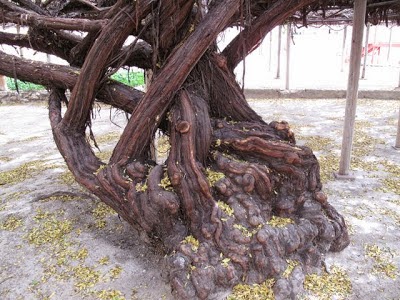
Our last visit was in celebration of our engagement. It was very meaningful to us. We discovered our own, "Tree of Life." The gnarled roots of the Tombstone Rose bush formed a Celtic knot. It's tiny roses were in full bloom symbolizing our hearts opening to each other.


The clipping we took home to commemorate Dan moving in.


Our little tree today, still thriving after 7 months. 
(Be durned if I'll let it die, it representing our relationship and all. lol)

Can our "tree of life" hold up to the weight of our first Christmas? 


Yes! It can! 

Our "tree of life" on our one year and one month anniversary! 


Wednesday, December 14, 2011

From Pioneer Lady to Whip-lashin' Gunslinger

Jana Segal


The success of my historical reading actually lead to a "paid" gig (Well...$50.) with a Mystery Theater Group - the Candlelight Players. So I went from playing strong pioneer lady, Mary Ringo, to the rough, whip-lashin', gunslinger, Buffalo Lil. It had been 20-some years (about the same amount of time that I was married) since I had been in a play. After hearing about my performance in Tombstone, my friend Andy recommended me for the role (in part to distract me from my impending divorce.)

So while I was trying to develop my character and memorize my lines, my soon-to-be-ex would call several times a  day about the divorce. Sometimes the play was a distraction from the divorce and sometimes the divorce distracted me from the play. I was so tired from dealing with all my ex's crap, that it was like pulling teeth to even read the play before the first read through. But Andy, with his hilarious Speedy Gonzales accent, lightened things up. By the time we got the play on it's feet, there were glimmers of the old passion I had for acting before I got married. I had forgotten how much I loved to act!


I enjoyed discovering my character's voice. When I had problems distinguishing my character from all the other Western characters, the director wisely recommended that I look at Dustin Hoffman's tomboy sister in "Little Big Man." I watched her three scenes over and over until I got a handle on her vernacular and then I transferred her cadences to my lines. Then I recalled a similar character from Deadwood - Calamity Jane. I found her scenes on Youtube and got my character's attitude from her. Finally, I learned how to crack a whip. Now I was having fun!

But the best part was running lines with my two hammy sons. (They had been sorta distant since their father left the house.) Usually I help them learn their lines (which they get a lot easier than I do.) It actually helped me to bond with my 12 year old when he gave me my cues on route to his Live Theater Workshop class. He started hugging me for the first time in this life!

But the day before the performance, when I wanted to put the finishing touches on my lines, my ex tells me he is taking the boys for the weekend to prepare them to live with him every other week. I spiraled into depression. I read the same line over and over - it was meaningless.

I ended up running through my lines on the 45 minute drive to the resort and while we waited to go on. And there was plenty of time waiting around - first, for the audience to eat dinner and then to read the clues and finally to figure out the mystery. Once I got my lines, I had so much DOWN time that I started to get depressed again! I was afraid I wouldn't get it back up for the finale!

But it all turned out fine. I actually helped other people when they forgot their lines. At the climatic moment, when the shot gun sound effect didn't go off,  I was the one to say, "Bang!" and even got a laugh. In fact, I got six big laughs in all. Thanks to my buddy Andy.

Tuesday, November 8, 2011

Rehearsing and Performing my Reading of Mary Ringo's Pioneer Journal

When preparing for my reading of Mary Ringo's pioneer journal, I had to decide which journal entries to include. There was A LOT of tragedy on this journey, so I wanted to break that up by including entries with interesting details on camping – so the audience could get a glimmer of life on the wagon train and so there would be peaks and valleys in the performance. This would give me a chance to express other emotions aside from the fear and rising anxiety over the impending Indian attacks. For instance, I express her delight at seeing the beautiful scenery and the joy of watching the children discover a steamboat. I like to have as much variety as possible so it won't become one note.

Rehearsing for a reading can be tricky. Different than rehearsing for a play. With play acting you need to memorize the lines precisely without memorizing the inflections. Some directors have you do improvisation so you stay as spontaneous as possible. When rehearsing for a reading, you need to practice reading it out loud enough so you are comfortable articulating the exact wording and don't garble the words. It helps to know the subtext (internal dialogue). When I type the manuscript I double space so I can write cues for the emotions above the dialogue. But you have to know it well enough so you're aware of the transitions from one emotion to another. It won't do to figure out the emotion half way through the sentence. This is where pauses can come in handy. I put a slash where I need a pause to shift from one emotion to the next. Pauses are also great to add drama. Sometimes Mary would write about some very dramatic event in a very matter of fact or dry manner. A few well placed pauses can really build the dramatic tension. A guy came up to me after the reading and said that he was afraid I was going to pass out from all the anxiety. The anxiety that he (and I) felt came from the pauses.

So how much do you rehearse? It's all about balance. You don't want to practice so much that it becomes dull and you are forcing the emotions. I was lucky to have a manuscript with a very dramatic ending. The writing wasn't stilted at all. The words and rhythm expressed real heartache. The first time I read it aloud, I cried. This is good and bad. It is good because you know that the feelings are there. It is bad because you don't know if you'll ever be able to access them again – especially if you over work it. I opted on the side of less work.

After going through and marking the script with the subtext and emotional cues, it is time to read it out loud. First, I just need to get used to hearing my own voice. I don't worry too much about inflection. If I stumble on a word that is hard to pronounce, I repeat it until I can say it with ease. As I re-read it, new subtext starts to emerge so I tweek my notes and pauses. I work on a section at a time until I get rid of enough kinks to get all the way through it. When I finally got to the climax – I actually cried! I set it aside so I wouldn't overwork it. The next day, I read it all the way through without stopping at each mistake. Finally, I time it. Good. It's in the alotted time frame. I stop for the day.

Friday, November 4, 2011

When I get to Tombstone, I wander the streets. There is a lonely wind blowing – as I miss absent friends. I go back to my room and read through the whole manuscript – except for the emotional climax. I don't want to overwork it. I hope the tears will be there when I need them.

Saturday, November 5, 2011

The next day - the day of performance, I have about two hours to get ready. I read the beginning and start to feel a little anxiety. I take a long shower – belting out a song or two. I take my time putting on my modest makeup and put my hair up in a bun. I casually read the manuscript out loud one last time. It's not perfect. I don't even get choked up at the end. I leave the performance in God's hands. It is really an act of faith at this point. I put on my school marm dress, lace up my period shoes and head for the performance venue hoping for the best.

When I get there, they seem to be behind schedule. One speaker finishes his speech and another goes up. I try to stay relaxed. I wonder if I should go run through it one last time, but decide that that would only make me more nervous. The second speaker finishes his presentation and takes questions. I go to the ladies room to adjust my shawl and put on my bonnet. Jenn, the organizer, finally announces me. I walk to the front and set up a shaky metal stand, place my manuscript on it, and adjust my mic. I ask the audience, “How many of you have heard of Johnny Ringo?” They all raise their hands. I give a short intro on how this is Johnny's mom's journal of their trip cross country in a covered wagon . This intro gives me time to acclimate to my surroundings and the audience.

This is it. My hand shakes as I adjust the mic, but I know I can use the nerves to my advantage. The reading is going pretty well. I wish I had practiced a bit more so I could look up at the audience more often. I mess up a couple of lines, but I stay in character and keep going. Then I start to get into it. I surprise myself with some new expressions in the heat of the moment. The pauses that I planned are starting to build tension. And there it is. The climactic paragraph. I pause to reflect for a moment. When I resume, the emotion is all there. I tear up as I tell of my husband accidentally killing himself. I bow my head in reverence to God. And it is over. The audience applauds. Several people come up to me and tell me how good I did. Mark D says that the audience was so mesmerized that you could hear a pin drop. Thank God!

Sunday, September 11, 2011

My Storytelling Journey


Jana Segal

I started attending Tucson's Teller of Tale's storytelling meetings three years ago. As a part of each meeting we would go around the room introducing ourselves. Every time I would say, “I'm here to enjoy the stories and hopefully get inspired to do a story some day.” This went on for years, until one day... they stopped having introductions.

It had been so long since I had been in a play - since before the kids were born. But I finally got that ol' itch to perform again. So when master storyteller Glenda Bonin offered a storytelling workshop, I dug out my one-woman “storytelling” musical, Magic Shoes, polished it up, and e-mailed it to her. Knowing my theater background, Glenda cautioned me about trying to act. Storytellers TELL their stories off the top of their heads. Enchanted by the story, she agreed to let me read (and sing) it at the storytelling workshop anyway. With all the carefully crafted description, we discovered that it was really more of a one-woman musical than a storytelling piece. I watched in awe as the other students actually told their stories – hoping to become inspired to do it too. Someday.

Someday came sooner than I expected when Glenda asked me if I wanted to work on a story for the professional studio recording of TOT members. While listening to other members practice, I finally got inspired! I remembered Sharlot Hall's 1880's Christmas story, “The Fruit of the Yucca Tree” that I had adapted for my short chick Western, Desert Angel. I was excited about revisiting that touching story. So I condensed it and revised it and started memorizing it (which I wasn't supposed to do) and got cold feet. I told Glenda I wouldn't be able to do it. It had been so long since I had even memorized a monologue.

Glenda gently encouraged me. She suggested that I read the story for the recording. And I sure hated to miss this opportunity to be recorded on a CD with professional storytellers! She made it so easy for me. I practiced it on my own. Then she timed my story as I read it over the phone. She said it was a lovey piece. I wasn't sure if I was ready, but thanks to Glenda's support and incredible patience, I got through it. I am proud to be on a professional storytellers' CD.

Since I was already practiced up, I volunteered to read the story for the Tombstone historians and enthusiasts at the Tombstone Territory Rendezvous. Unfortunately, some of us went dancing the night before and I must have been shouting over the music, because the next morning my voice was horse and barely audible. Afraid that no one would be able to hear me, I tried to arrange for a microphone - with no luck. When I got up to the podium, I found that I couldn't see the words on the page. I had to wear my new glasses. (Which also made me feel old since last time I was on stage I didn't need glasses.) A friend in the front row said that I looked nervous for a moment as I adjusted my glasses. The next thing I knew, it was over and the audience was applauding. Historian Casey Teffertiller graciously commented that I had a gift!

After that Glenda said it was time for me to do actual storytelling – not a reading, not a memorized monologue. She said I knew my story and I should just “tell it” at the annual TOT Christmas party. At Glenda's suggestion, I made an outline and tried to visualize the story. Lounging on our host's sofa, my fellow storytellers took turns telling their favorite Christmas stories. My story would fit in perfectly! I opted for more bean dip instead.


I discovered that I knew it better than I thought when the dialogue kept running through my head. So, after recovering from the shame of not performing, I agreed to do the storytelling performance to promote the Teller of Tales CD at Bookmans. I decided that it was alright to memorize the dialogue because of the distinct old timey dialect. It shouldn't be that hard because it was the same dialogue I knew from my short film. And I worked at paraphrasing the rest. I wasn't at all sure that I was ready for this. I was scared to death that I would forget a line and lose my place. But with my son Vlad there for support, I ran the story through in my head on the bus ride to Bookmans. Vlad helped me on with my 1880's apron and I went for it. There were sections I forgot, but in the grand tradition of theater, I kept going. And then it happened. I started telling it to the two little kids in the audience. (Vlad tells me the kids laughed.) I know their mom hung on every word! Then, just like that, it was over. Glenda asked if I wanted to do it again. Heck, no! I just got through it!

Monday, August 22, 2011

Our "Little House on the Prairie" Dresses


Jana Segal

While my mom devoured the Little House books, I was more into the TV series. As a child, I remember being glued to the TV to watch Half-pint (Laura), Mary, Ma and Pa on Little House on the Prairie every week. My pre-adolescent heart beat a little faster when curly haired Michael Landon flashed that gorgeous smirk of his. My annoying father would walk in front of the TV flicking his tongue distastefully, “Bluck. Bluck.” But that show meant a lot to me. I always wanted to be an actress and child star Melissa Gilbert gave me hope with her two front teeth slightly protruding. In addition to our matching smiles, I resembled her in other ways - especially that button nose. (Imagine my dismay when my childhood doppelganger had her nose and teeth fixed.)

A popular show in the 70s, Little House on the Prairie had an impact on the fashions of the time. I remember all the girls at church wearing long, maxi dresses. In our family there was very little money to buy new cloths. Mostly we wore hand-me-downs and thrift shop finds (way before it was trendy.) I remember one of the few times we got something new. Dad had gotten free tickets to the fair. I don't know what possessed him, but he bought all five of us girls - mom included - matching pink and white gingham maxi dresses with bonnets. (One of us must have destroyed the Polaroid of the five of us from Mom, teenage me, preteen sis on down to the baby in our matching Little House on the Prairie dresses.) We had so few clothes so at any given time at least three of us had to wear the offending dresses to church on Sunday. Oh. Oh. Painful memory. In the church parking lot. Climbing out of the bed of the truck wearing my Little House maxi dress and tennis shoes.

Despite the embarrassing dresses, I was always loyal to the program. Growing up as the oldest daughter, I was a timid, overly obedient child. My one act of rebellion was standing up to my dad when he forbid me to watch my beloved Little House on the Prairie because it was too dramatic and “sappy.” I remember crying, “Mom! It is so unfair!” This was the most wholesome, Christian show on television!

It's funny how things come full circle. After I was grown and married, mom dug out one of the gingham dresses for my costume collection. When she and my nieces came to visit us, we dragged out my costume box and all dressed up 1880's style to visit the old West tourist town of Tombstone. One of my little nieces continued the family tradition by wearing the pink gingham dress and bonnet with her tennis shoes!

Saturday, July 9, 2011

If the Dress Fits - the Making of a $99 Movie


by Jana Segal

After I recovered from the trauma of making a 17 minute Western in 18 hours, several people from my directing group suggested that it might be easier to make a really short short next. At that time, IFP Phoenix (then called the Phoenix Film Project) had a 24 hour film contest that allowed you $100 to shoot a three minute film. That was all the inspiration I needed! I started pre-production by reserving a mini DV camera and lighting equipment at Access Tucson http://accesstucson.org/ and writing a three page script called, “If the Dress Fits.”

The $100 budget rule was very freeing because when I approached merchants requesting donations, they couldn't haggle over the price. I enlisted the help of the Tombstone Chamber of Commerce president convincing her that my $100 video would be a great advertisement for the tourist town of Tombstone. Together we moseyed down Allen Street where she introduced me to several local merchants. Meanwhile, I was also making a documentary on the making of a $99 film, so there was a video camera aimed at the merchants while I hit them up for donations. This proved to be extremely helpful. I'll never forget the nervous smile on one dress shop owner's face when I explained I couldn't pay because of the $100 rule. (And I don't have to because I got it on tape! Hahaha!) But she came through by volunteering her shop for a location. (I have admit it was cool to shoot where one of Tombstone's notorious bad guys was shot.)

I don't know if it was the loaded camera aimed at them, but everyone in Tombstone was so nice and helpful. Whenever I'm in town, I still stop by to say, “hi” to the nice woman who let us shoot in her historic B & B. She had even recruited her whole family to work as extras in full period garb.


“If the Dress Fit.” is the story of a modern city gal who is dragged to Tombstone, Arizona to approve the "Wyatt Earp" suit her dorky fiancee wants to wear to their wedding. She tries on an antique dress that triggers memories of her past life in the 1880s. After reading my script, my directing group gave me some excellent feedback. They said it seemed like an awfully complicated story for a three minute film. I really should have listened, but I was dying to shoot my story in Tombstone. When I first visited Tombstone in 1996, I felt an instant connection. (Which is strange because I never really liked Westerns growing up.) I especially felt drawn to the Birdcage Theater which I visited every time I was in town. I loved hearing the history of this wild honky-tonk and the rumors that it was haunted. I can still point out all the bullets that riddle the walls. Eventually, the manager started letting me in free as honorary Tombstone resident.

Thrilled for any excuse to visit Tombstone, I went there to scout locations and do some casting. I was tickled to get the Tombstone Cowboys who performed my favorite stunt-show at the Heldorado stage. One of the stuntmen at the time was Chris Simcox (who later earned notoriety for starting Civil Home Defense to patrol the border with guns.) We recorded one rehearsal where I explained my convoluted story to him. He mugs into camera as if to say, “What the heck is this crazy lady talkin' about?”

I returned to Tombstone for a read-through with the cast. The Birdcage manager kindly let us use the backstage area for our rehearsal. I was so jazzed! I thought rehearsing there would help my actress get closer to her character (who had worked at the Birdcage in her past life.) But when we toured the theater, the actress started feeling nauseous and faint. I figured it must be allergies to the dust. She finally ran out of the room holding her stomach, “I have to get out of here!” Later, she explained that she had seen someone she knew from a past life up on catwalk. Spooky. I guess she was a little too close to the part.

The 24 hour rule worked to my advantage and disadvantage. The fact that it had to be shot in one day was a great selling point for my volunteer crew. I was lucky enough to get a professional DP (camera man) and experienced actors to agree to work for free for only one day. Of course, it would only take one delay to throw the whole schedule off. But what could go wrong?

Anyone who has ever worked on a movie set knows – anything that can go wrong, will go wrong. We were all set up to shoot the first scene, but one of the actors showed up late throwing off the whole schedule. When we finally got to the next location, all the extras for our crowd scene were long gone. When your DP brags that he can make two people look like a crowd, don't believe him. He cant. Without the crowd to show that it is a gunfight reenactment, the movie doesn't quite make sense.

So I learned two lessons from this: 1) Listen to your director friends when they tell you can't make a complicated story in three minutes. 2) Don't have more then one or two locations for a one day shoot. Unfortunately, we had four: the dress shop (exterior and interior), the stunt-show set, the bordello room. A shot of the Birdcage would have been nice too. Very nice.