Showing posts with label Tombstone Territory Rendezvous. Show all posts

Wednesday, November 12, 2014

Halloween at Leroy's Tombstone

Tombstone Territory Rendezvous Halloween Weekend


What better place to spend Halloween than in Tombstone with Western history buffs and researchers who unearth stories of the dead?

October 30, 2014. Appropriately, Dan and I started our Halloween weekend on a day trip with the Tombstone Territory Rendezvous gang to Johnny Ringo's grave followed by a stop at Gleeson ghost town.


We all gathered around a tree believed to be the place Johnny's dead body had been discovered, while an intuitive cowgal seemed drawn to the fallen tree nearby. Was this really Johnny's tree? Or did she know something we didn't?

October 31, 2014 at rickety Schieffelin Hall reading the love letters of dead people.


I performed a dramatic reading of Mary Clum's last letter to her mother-in-law proclaiming how Tombstone and its weather agreed with her. "I've never felt so well in my life...as I do now." And then I read her husband, John Clum's, letter sharing the sad news that his dear wife had gone to be an angel.


Can't say I channeled Mary or John Clum - although I did get a little teary-eyed reading his heart wrenching letter. Hope Mr. and Mrs. Clum were mighty pleased with my reading.

The rest of the afternoon was spent making the acquaintance of a few of Tombstone's deceased mayors via PowerPoint presentations. Then we were transported back to the 1880's through period music presented by Paul Johnson.

 Old timey saloon music

After spending the day hearing about dead people, Dan and I were in just the mood for a Halloween ghost tour at the infamous Bird Cage Theatre.


From my first visit to Tombstone, I felt drawn to the Bird Cage Theatre. For me there was a sense of nostalgia in the dusty air. Every time I came to town, I felt compelled to chat with Bird Cage manager, "Lightnin' Leroy." I would wait around in the lobby for him to finish his spiel about the longest running poker game (24 hours a day for 8 years, 5 months, and 3 days) and how many bullet holes decorated the walls (over 140). Leroy would then spin yarns about winning quick shot competitions and the hotshot cowboys who challenged him on the streets, guns at the ready. Around this time, the Bird Cage was featured on Haunted History. But Leroy always seemed the skeptic when it came to ghosts - even as he shared the photo he kept behind the bar of the spooky orbs shot in the theater. But he admitted to feeling a cool breeze and getting a whiff of cigar smoke or perfume when he was closing the theater alone at night.

Leroy became the inspiration for a character in my comic screenplay, "Behind the OK Corral." While conducting research for it, I returned to the Birdcage with a group of psychics. Two of the ladies, at separate ends of the theater, simultaneously pointed up to the same crib and said, "See the big Madame in the green dress!"

Madame in green was in crib in back corner

This really struck me because of a similar incident on a previous visit...

I was in town to shoot my short film, "If the Dress Fits."

When I couldn't find a place to rehearse, Leroy generously offered the use of the Bird Cage stage. While touring the theater after the rehearsal, my actress suddenly got ill. She cried out, "I have to get out of here!" I figured it was an allergy to all the dust. She later admitted to seeing someone she knew in the cribs, someone from a past life. A madame with a green dress!

It's been a while since I finished my screenplay, and I no longer feel the same draw to the Bird Cage. (Perhaps in the process of writing, I had resolved my issues.) Though I occasionally bring family and friends. Once I gave a tour to a descendant of Mabel Earp Cason (Wyatt's cousin who collaborated with Sadie on the manuscript that would become, "I Married Wyatt Earp.")  But I ran into Leroy less and less. Then I heard the tragic news. That July, Leroy was shot down in front of his house by a local drunk.

It was weird going back to the Bird Cage with no "Lightnin' Leroy." But there we were on a ghost tour. The guide showed us the cribs in the balcony where the soiled doves (prostitutes) plied their trade. She informed us about the different kinds of paranormal phenomenon. Apparently she boned up on the facts from "Ghost Hunters."


She took us downstairs to the site of the longest continuously running poker game. We peeked into the more expensive $25 dollar a night rooms. She went over the rules on how to treat the ghosts with respect. Apparently they don't like it when you talk about Ouija boards or challenge them to prove they exist. They are there for the interaction. She made an excuse that the ghosts seem less active on Halloween. (Hmph!) Perhaps it's their one night off. One of the tourists, my boyfriend Dan, pointed out a bad smell that wasn't there before. I got whiff of the musty odor.  It smelled like something was rotting in one of the $25 rooms. The guide said that she didn't notice it on the last tour. She would check for a dead rat in the morning.

The room with the rotting odor

We went upstairs to the backstage area and found seats around a wooden table. The guide pointed out all the lights already in the room, so we wouldn't get a false experience. She placed two gadgets on the table: one that sensed paranormal energy and another that amplified paranormal sounds on FM and AM channels. She encouraged us to ask questions of the ghosts and turned out the lights. Our ears peeled for the slightest ghost whisper or footstep, we waited in the dark. No lights on the machine. We heard laughter. The guide said that's just partiers celebrating Halloween. Not the best night for ghosts. Our guide tapped on the table and asked the ghosts to tap back. Nothing. She tried again. "Do you hear that? Tapping on the stage?" Some tourists claimed they heard rapping on wood. I heard nothing. She asked, "Hear that? The clinking of poker chips downstairs?" No...(pout). I just heard the young woman in our group giggling. Dan thought he heard a little hand bell. The guide tried to talk to the ghosts and guilt them into speaking to us. "Hey, guys. This is Halloween. You don't want to disappoint these people." One of the women said that someone touched her hair. The guide switched the receiver to AM. The woman asked the ghost who he was. Something garbled came through the receiver. "Are you the one with the bad odor we smelled downstairs?" Ha! How rude! Someone thought they felt a presence walking behind their chair. Another woman exclaimed, "There's a hand on my head!" The young woman cried out, "I'm scared!"

Location where I saw the light

Staring towards the stage, I thought I saw a light. Finally, the guide wrapped it up. She claimed that we heard more than the last group: the tap in response to hers, the voice on the spirit amplifier, and the woman's head being patted.

Wish I could say I saw Leroy, or even the Madame in green, but I didn't.  After the tour, I asked the guide if she knew Leroy. Leroy had hired her. She was at the Bird Cage when his killer came downtown to brag about shooting Leroy. I asked, "You think Leroy ever drops by?" She shared how Leroy used to hate it when she was on her cell phone at work. Once, her cell phone went flying off the display case. She believed it was Leroy pushing it off and that he occasionally stops by to check up on them.

Leroy Colomy

The Bird Cage sure isn't the same without ol' Lightnin' Leroy doin' his spiel. I wonder if Leroy is still a skeptic when it comes to ghosts. Wonder if he ever met up with a cigar-chomping miner or a soiled dove with a familiar fragrance of perfume.

Wednesday, November 5, 2014

Ringo's Grave

I feel like I'm coming full circle finally seeing Ringo's grave site. I had performed a dramatic reading of the pioneer journal of Johnny Ringo's Mama at Tombstone Territory Rendezvous in November of 2011.


Is this really Johnny Ringo's grave?


While everyone else crowds around one tree, Karen makes herself comfortable on a fallen tree.


Ron Woggon gives a speech on how Johnny Ringo's body was found sitting on this tree. There is a long standing debate on whether he killed himself or was shot, (In the movie, Tombstone," Doc shoots him) and whether he was moved here. There is a discussion about where the bullet holes entered his head. Everyone is a CSI expert these days! lol. At the time of Johnny's death, the coroner never even saw the body before writing the report that we scrutinize today.


The people in the nearby house, didn't even hear the gun shots.


Dan, being the brash newcomer, adamantly proclaims that this tree is too young to be the right tree.


I love my baby!


Karen feels drawn to the fallen tree and starts digging around for the rock that was at the base of the tree.


On Angel Wings and a Prayer

It is night time before we finally hit the road for Tombstone - too dark to read in the car. Instead of practicing for my reading, I sing the songs for my musical theater showcase at Live Theater Workshop (the day after my Tombstone reading.) Dan is so patient as I sing, "Into the Woods!" for the ga-zillionth time.

At Tombstone Territory Rendezvous...

Thursday: After a lovely day trip to Ringo's grave and Gleeson Ghost town, we head to Schieffilin Hall for lectures. The first one is a powerpoint of John Clum based on Gary Ledoux's book! And there are our photographs from Special Collections. The photos we were using in our presentation! The photo of the Clums' white house! Only the caption says it is the home of John and his second wife. This drives us crazy, because in our fervor as new researchers, we are sure that it is John and Mary's house! 

Friday:  My performance is this afternoon. We skip the field trip to the old baseball field so I can practice. But The Tombstone Epitaph is just across the street from our hotel.


We stop in just to ask if they have a copy of the paper about the Townsite issue. Nope. Or if they know the location of the Clums' house...Nope. Maybe Woodie Clum's book has the address... Nope. They explain that, "Apache Agent: The Story of John P. Clum," by Woodworth Clum is out of print. 

Caught up in the search, we stop at the visitor center and ask to look at a plat map, a surveyors map of all the lots in Tombstone. They give us a historical town map, but the Clums' house isn't listed. 


We stop at every book store in search of the elusive book. We use the wifi at Wyatt's Coffee Shop so Dan can download new photographs for the presentation, while I worked on my bio and introduction.

Two hours left until my presentation! I leave Dan at the courthouse bookstore and rush back to our room.  And I still have to put my hair up in a bun and dress up in my "school marm" outfit." One thing good came out of our research...Since we didn't find the article about the townsite issue, I concentrate on telling John and Mary's story. I manage to read three letters out loud. Can't wrap my mouth around the word "seraphic." (John says his wife has become an angel...) Didn't have time to practice the eulogy at all. 


Passed some friends on the way to Shieffilin Hall and they looked pleased that I was in full period wear.

I have 15 minutes to practice at the podium, but people come into the hall to escape the hot lobby. I end up practicing in the hot lobby. Still can't pronounce "seraphic." 


Eric Eardman (a descendant of Wyatt Earp) introduces me, I take off my black bonnet at the podium and say a silent prayer.


I set the stage by reading an excerpt of John's love letter, "My Dear Darling, Precious little sweetheart. My pretty dear. My beloved little wife. I am sorry I can't kiss you tonight." My hand shakes a little as I read the first letter that Mary wrote to her new mother-in-law describing their wedding. Then I read her last letter to her mother-in-law detailing their daily life including the Townsite issue. I rave about the weather and how I have never felt so well in my life. I gush as I describe little Woodie's doings and sayings.


I fold my hands as I read, "At night he says his prayers so cute. Now I lay me, etc - crossing his little hands - then kisses me, papa and Grandmama. He wanted dolly to say hers so he said the entire prayer and remarked "dolly said at." Finally, I tear up a bit as I read John's letter sharing the news of his dear departed wife going to Heaven to become an angel. My mouth is dry, so I still can't pronounce "seraphic."  I say, "Sorry," and take a sip of water. 

All in all, it turned out to be a really rewarding experience. As I head back to my seat, a twenty-something man says, "Thank you."


It was a good thing that I included the Townsite issue. Bob Palmquist elaborated on it in his lecture. He referred to my presentation three times. He seemed to really appreciate that I had shared the Clum's letters. My friend Soni later responded on facebook, "Thank you for SUCH a great and informative performance last weekend! I learned a lot and will never look at the Clums the same way again! lol"  Thanks, Soni! 

That night we celebrate with a stroll down Safford Street scouting out the Clum's house.

This is NOT the house.

According to Parsons, it was supposed to be "down the street from a church." We find St. Paul's Episcopal Church. (It was actually the wrong church.) Town lot researcher Nancy Sosa explains that the house is no longer on that lot. She laughs at the thought of us looking for a house "down the street" from the church. In a small town like Tombstone, every lot is just down the street.

On the last day we find Woodies' book behind glass at the Epitaph office.

Tuesday, November 4, 2014

Wrapped up in research, I forget to rehearse.

After going through Mary and John Clum's letters at the U of A Libraries Special Collections, I decide to perform Mary's last letter to her mother-in-law.

I am especially excited to include Mary's insights on the Townsite issue. (I figure this should be of great interest to the researchers and historians at Tombstone Territory Rendezvous.) In the letter, Mary writes, "It is a great outrage to move people off their lots by man force. They tried to move a house last night but did not succeed as the Marshal interfered and put a stop to it.  This morning the citizens moved it back to it's former position. Clark, Gray, and Co. felt somewhat chagrined but do not dare offer any resistance. The entire public is against them. I hope no violence will be used...We have two nice lots of our own and our little house and are comfortable, so are deeply interested in the question at issue."

Intrigued, I put off packing for our Tombstone trip and practicing for my dramatic reading. Instead, I delve into my personal library of Tombstone history. I uncover comments about the Townsite issue in the correspondences of Clara Spalding Brown in, "Tombstone from a Woman's Point of View," and the private journal of George Whitwell Parsons from, "A Tenderfoot in Tombstone." (Both edited by Lynn Bailey.)

Parsons has several entries about the subject as he was heavily engaged in fighting Clark, Gray and Co. about their rights to the town lots. He mentions obtaining two lots himself with Rev. McIntire near the Clum's house on Safford Street. He thinks having the Rev. on his side will help, but also describes the attempt to move the Judge's house while the Judge is away. A judge even! What nerve!

Mary Clum's letter and George Parsons' journal both discuss Clum's articles regarding the Townsite issue in his paper, The Tombstone Epitaph.

I wonder out loud if I can get a copy for my reading. Dan, my ever curious, ever helpful beau, does a search for copies of that paper. Unfortunately, he can't find any copies of the Epitaph from that time period, 1880-81.

Caught up in this research, neither of us gets anything we need to get done for our trip that night. And my reading is Friday! Ahh!

There's always Tombstone...

Wednesday, October 29, 2014

Celtic Knot in Our Tree of Life


Looking forward to returning to Tombstone with my soul-mate, Dan.


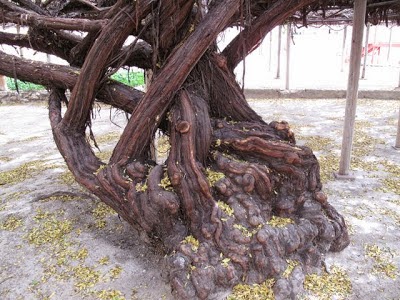
Our last visit was in celebration of our engagement. It was very meaningful to us. We discovered our own, "Tree of Life." The gnarled roots of the Tombstone Rose bush formed a Celtic knot. It's tiny roses were in full bloom symbolizing our hearts opening to each other.


The clipping we took home to commemorate Dan moving in.


Our little tree today, still thriving after 7 months. 
(Be durned if I'll let it die, it representing our relationship and all. lol)

Can our "tree of life" hold up to the weight of our first Christmas? 


Yes! It can! 

Our "tree of life" on our one year and one month anniversary! 


Monday, October 27, 2014

The Clum Letters: Through the Eyes of Mother Clum

While preparing for my dramatic reading at Tombstone Territory Rendezvous, I conducted research on Epitaph editor and Indian agent John Clum (He actually captured Geronimo!) at the U of A Special Collections library. After poring over Clum family letters, I have decided to portray John Clum's mother reading letters from her son and his wife, Mary. I plan to include: the first letter Mary wrote to her new mother-in-law in which she shares the details of their wedding, Mary's last letter before dying in which she tells about her life in Arizona, and John's letter sharing the sad news of his dear wife's death (as well as the newspaper clipping he enclosed.)


Tuesday, October 21, 2014

Dear Maddie: Researching Tombstone Mayor John Clum's Letters to His Dear Wife (or They Actually Let Me Touch Historical Letters!)


Researching John and Mary Clum in Special Collections at the U of A.


by Jana Segal

It had been a few years since I performed the dramatic reading of John Ringo's mother's pioneer diary at Tombstone Territory Rendezvous, so I was eager to perform another historic reading. TTR organizer, Jean Smith, suggested that I do something on the wife of one of the mayors of Tombstone since this year's program already included several prominent men. I googled "mayors of Tombstone." At the top of the list were the current mayor of Tombstone and John Clum. John Clum - Earp supporter, Epitaph founder, and Indian agent! His wife at the time was Mary Clum. I was intrigued to find out more about her. Someone was already scheduled to do a presentation on Mayor Clum based on Gary Ledoux's new book, so Mrs. Clum would fit in nicely. Following that lead, I discovered Gary Ledoux on facebook and asked him if he had any copies of the Clums' letters. He didn't, but he graciously sent me some pages from his book that included excerpts from Clum's April 16th letter to his wife (written while serving at the Southern Apache Indian Agency where he captured Geronimo.) I had a date to work with! A google search for that letter, led to a collection of the Clums' letters in the University of Arizona Libraries Special Collections.


I was tickled to find how easy it is to look up historic documents at Special Collections. The research librarians were so helpful bringing up boxes full of folders with letters, newspaper clippings, and old photos. (I imagined them scooting their little cart by row after row of artifact boxes like the iconic scene in "Raiders of the Lost Ark.") Plastic envelopes held the fragile, aging letters. I couldn't believe that I was allowed get my grubby mitts (or white gloves) on 130 year old love letters! I read Clum's letter to Major J. F. Wade from the the 9th Cavalry detailing the capture of Geronimo. I struggled to decipher the Clums' messy handwriting and smiled at their gushing affection. Finally, I happened onto John's letter to his mother sharing the heartbreaking news of his wife's death. Profoundly touched, I knew that I had to share their story with a dramatic reading of their letters.

Tombstone Territory Rendezvous will be held October 29th to November 2nd.


Tuesday, November 8, 2011

Rehearsing and Performing my Reading of Mary Ringo's Pioneer Journal

When preparing for my reading of Mary Ringo's pioneer journal, I had to decide which journal entries to include. There was A LOT of tragedy on this journey, so I wanted to break that up by including entries with interesting details on camping – so the audience could get a glimmer of life on the wagon train and so there would be peaks and valleys in the performance. This would give me a chance to express other emotions aside from the fear and rising anxiety over the impending Indian attacks. For instance, I express her delight at seeing the beautiful scenery and the joy of watching the children discover a steamboat. I like to have as much variety as possible so it won't become one note.

Rehearsing for a reading can be tricky. Different than rehearsing for a play. With play acting you need to memorize the lines precisely without memorizing the inflections. Some directors have you do improvisation so you stay as spontaneous as possible. When rehearsing for a reading, you need to practice reading it out loud enough so you are comfortable articulating the exact wording and don't garble the words. It helps to know the subtext (internal dialogue). When I type the manuscript I double space so I can write cues for the emotions above the dialogue. But you have to know it well enough so you're aware of the transitions from one emotion to another. It won't do to figure out the emotion half way through the sentence. This is where pauses can come in handy. I put a slash where I need a pause to shift from one emotion to the next. Pauses are also great to add drama. Sometimes Mary would write about some very dramatic event in a very matter of fact or dry manner. A few well placed pauses can really build the dramatic tension. A guy came up to me after the reading and said that he was afraid I was going to pass out from all the anxiety. The anxiety that he (and I) felt came from the pauses.

So how much do you rehearse? It's all about balance. You don't want to practice so much that it becomes dull and you are forcing the emotions. I was lucky to have a manuscript with a very dramatic ending. The writing wasn't stilted at all. The words and rhythm expressed real heartache. The first time I read it aloud, I cried. This is good and bad. It is good because you know that the feelings are there. It is bad because you don't know if you'll ever be able to access them again – especially if you over work it. I opted on the side of less work.

After going through and marking the script with the subtext and emotional cues, it is time to read it out loud. First, I just need to get used to hearing my own voice. I don't worry too much about inflection. If I stumble on a word that is hard to pronounce, I repeat it until I can say it with ease. As I re-read it, new subtext starts to emerge so I tweek my notes and pauses. I work on a section at a time until I get rid of enough kinks to get all the way through it. When I finally got to the climax – I actually cried! I set it aside so I wouldn't overwork it. The next day, I read it all the way through without stopping at each mistake. Finally, I time it. Good. It's in the alotted time frame. I stop for the day.

Friday, November 4, 2011

When I get to Tombstone, I wander the streets. There is a lonely wind blowing – as I miss absent friends. I go back to my room and read through the whole manuscript – except for the emotional climax. I don't want to overwork it. I hope the tears will be there when I need them.

Saturday, November 5, 2011

The next day - the day of performance, I have about two hours to get ready. I read the beginning and start to feel a little anxiety. I take a long shower – belting out a song or two. I take my time putting on my modest makeup and put my hair up in a bun. I casually read the manuscript out loud one last time. It's not perfect. I don't even get choked up at the end. I leave the performance in God's hands. It is really an act of faith at this point. I put on my school marm dress, lace up my period shoes and head for the performance venue hoping for the best.

When I get there, they seem to be behind schedule. One speaker finishes his speech and another goes up. I try to stay relaxed. I wonder if I should go run through it one last time, but decide that that would only make me more nervous. The second speaker finishes his presentation and takes questions. I go to the ladies room to adjust my shawl and put on my bonnet. Jenn, the organizer, finally announces me. I walk to the front and set up a shaky metal stand, place my manuscript on it, and adjust my mic. I ask the audience, “How many of you have heard of Johnny Ringo?” They all raise their hands. I give a short intro on how this is Johnny's mom's journal of their trip cross country in a covered wagon . This intro gives me time to acclimate to my surroundings and the audience.

This is it. My hand shakes as I adjust the mic, but I know I can use the nerves to my advantage. The reading is going pretty well. I wish I had practiced a bit more so I could look up at the audience more often. I mess up a couple of lines, but I stay in character and keep going. Then I start to get into it. I surprise myself with some new expressions in the heat of the moment. The pauses that I planned are starting to build tension. And there it is. The climactic paragraph. I pause to reflect for a moment. When I resume, the emotion is all there. I tear up as I tell of my husband accidentally killing himself. I bow my head in reverence to God. And it is over. The audience applauds. Several people come up to me and tell me how good I did. Mark D says that the audience was so mesmerized that you could hear a pin drop. Thank God!

Tuesday, September 27, 2011

Preparing a Reading of a Historical Document


Jana Segal

I had such a good time performing the reading of Sharlott Hall's short 1880's story, “The Fruit of the Yucca Tree,” at the Tombstone Territory Rendezvous last year that I decided to do another reading. After some discussion about what would be a good fit for this group of Tombstone enthusiasts, historians and researchers, organizer Jennifer Lewis and I came up with the idea doing a reading from pioneer letters or journals from the Southwest. Jenn generously did some speedy research and found, “The Journal of Mrs. Mary Ringo.” It's the mother of Johnny Ringo's accounts of her family's wagon train trek from Liberty, Missouri to Austin, Nevada. I perused the journal. It included plenty of hardships and Indian attacks! We were set!

So, how do you cut a 38 page journal into a 4 ½ page script?

First, I read it through marking all the juicy parts and possible story threads that could be built into a compelling story. For instance, I marked all the passages about Indians - including the interactions with friendly Indians so I would have rising and falling action. I wanted to show some of the scenic beauty along the way and their daily activities without getting too boring or repetitious. On a second read, I included a strand about the sick cattle. I figured that the TTR audience would be interested in anything about the young Johnny Ringo (who later became a famous outlaw) so I marked the little I could find about him. The most dramatic journal entry was Mary Ringo's account of her husband's death, so I decided to set up his character by including whatever I could find about him.

I typed up all the journal entries I had selected – double spaced to have room for the comments when I “break down” the script. Since this is a historical journal, I decided to stay true to it by not changing Mary's wording. But I did cut sentences here and there to lessen repetition and boring details (like how many miles they traveled each day.) I tweaked and cut until it flowed as a story.

Time for some research -

I did a little research to find out Johnny's age at the time of the wagon trip (Johnny was 14) and the route they were traveling (from Liberty, Missouri to Austin, Nevada). I also found some facts about Johnny that I could use in my introduction. Johnny Ringo (also known as Ringo) started his life of crime by killing a man in the Mason County War. He later ended up in Tombstone embroiled in a conflict with Doc Holliday. Wyatt Earp went after Ringo believing that he was one of the Cowboys responsible the murder of his little brother Morgan. My next step was to look up any old-timey words that I didn't know so I could interpret it accurately.

Next, I “breakdown” the manuscript.

I underline the words I want to emphasis and put slashes where I want to pause for effect. I mark different parts for tempo - for instance exciting passages that I want to read fast or sentences I want to sloooow down. I love it when I find a line I can YELL (and wake up that audience.) At this point, I practice it aloud and circle lines that are awkward to say so I can work on them. I might watch a period accurate movie set in the same time period to get a sense of the dialect. If I'm having trouble with some stiff dialogue, I might leave the page and try saying it in my own words to get more conversational.

Now I put on my actor hat, and re-read the journal for hints of who Mary was so I can flesh out her character. (For example, Mary Ringo bought a new dress along the way so she cared about her appearance. She also puts a positive slant on everything.) I might even write my own journal entry in her voice to really get in her head. I search for sections where I can add emotions and mark them. I ask myself how she would feel about a certain situation. Are there any clues about how she feels? I try to incorporate as many emotions as I can and contrast them. I work towards building the emotions to a dramatic climax.

How do I know when I've practiced enough?

I practice it until I know it well enough that I can look up from the page to the audience. At some point, I like to read it out loud to another person – so I get used to having an audience. This helps offset stage fright. If I can, I practice in the space to get comfortable there. It's really about reaching a certain level of comfort and confidence – then let me at it! I'm ready to perform!  

Sunday, September 11, 2011

My Storytelling Journey


Jana Segal

I started attending Tucson's Teller of Tale's storytelling meetings three years ago. As a part of each meeting we would go around the room introducing ourselves. Every time I would say, “I'm here to enjoy the stories and hopefully get inspired to do a story some day.” This went on for years, until one day... they stopped having introductions.

It had been so long since I had been in a play - since before the kids were born. But I finally got that ol' itch to perform again. So when master storyteller Glenda Bonin offered a storytelling workshop, I dug out my one-woman “storytelling” musical, Magic Shoes, polished it up, and e-mailed it to her. Knowing my theater background, Glenda cautioned me about trying to act. Storytellers TELL their stories off the top of their heads. Enchanted by the story, she agreed to let me read (and sing) it at the storytelling workshop anyway. With all the carefully crafted description, we discovered that it was really more of a one-woman musical than a storytelling piece. I watched in awe as the other students actually told their stories – hoping to become inspired to do it too. Someday.

Someday came sooner than I expected when Glenda asked me if I wanted to work on a story for the professional studio recording of TOT members. While listening to other members practice, I finally got inspired! I remembered Sharlot Hall's 1880's Christmas story, “The Fruit of the Yucca Tree” that I had adapted for my short chick Western, Desert Angel. I was excited about revisiting that touching story. So I condensed it and revised it and started memorizing it (which I wasn't supposed to do) and got cold feet. I told Glenda I wouldn't be able to do it. It had been so long since I had even memorized a monologue.

Glenda gently encouraged me. She suggested that I read the story for the recording. And I sure hated to miss this opportunity to be recorded on a CD with professional storytellers! She made it so easy for me. I practiced it on my own. Then she timed my story as I read it over the phone. She said it was a lovey piece. I wasn't sure if I was ready, but thanks to Glenda's support and incredible patience, I got through it. I am proud to be on a professional storytellers' CD.

Since I was already practiced up, I volunteered to read the story for the Tombstone historians and enthusiasts at the Tombstone Territory Rendezvous. Unfortunately, some of us went dancing the night before and I must have been shouting over the music, because the next morning my voice was horse and barely audible. Afraid that no one would be able to hear me, I tried to arrange for a microphone - with no luck. When I got up to the podium, I found that I couldn't see the words on the page. I had to wear my new glasses. (Which also made me feel old since last time I was on stage I didn't need glasses.) A friend in the front row said that I looked nervous for a moment as I adjusted my glasses. The next thing I knew, it was over and the audience was applauding. Historian Casey Teffertiller graciously commented that I had a gift!

After that Glenda said it was time for me to do actual storytelling – not a reading, not a memorized monologue. She said I knew my story and I should just “tell it” at the annual TOT Christmas party. At Glenda's suggestion, I made an outline and tried to visualize the story. Lounging on our host's sofa, my fellow storytellers took turns telling their favorite Christmas stories. My story would fit in perfectly! I opted for more bean dip instead.


I discovered that I knew it better than I thought when the dialogue kept running through my head. So, after recovering from the shame of not performing, I agreed to do the storytelling performance to promote the Teller of Tales CD at Bookmans. I decided that it was alright to memorize the dialogue because of the distinct old timey dialect. It shouldn't be that hard because it was the same dialogue I knew from my short film. And I worked at paraphrasing the rest. I wasn't at all sure that I was ready for this. I was scared to death that I would forget a line and lose my place. But with my son Vlad there for support, I ran the story through in my head on the bus ride to Bookmans. Vlad helped me on with my 1880's apron and I went for it. There were sections I forgot, but in the grand tradition of theater, I kept going. And then it happened. I started telling it to the two little kids in the audience. (Vlad tells me the kids laughed.) I know their mom hung on every word! Then, just like that, it was over. Glenda asked if I wanted to do it again. Heck, no! I just got through it!