Showing posts with label Tucson history. Show all posts

Saturday, July 11, 2020

Desert Victory Gardens


Inspired by empty grocery shelves and too much free time from sheltering in place, people rushed off to Home Depot to empty the shelves of gardening supplies. Many started their own "victory gardens." 

For you young'uns out there…Victory Gardens were made popular during WWII when people planted vegetable gardens to supplement their meager rations. The government promoted victory gardens as a way to support the war effort. They even offered a booklet to help first time gardeners. 

A peek at that booklet might be helpful.


1. Don’t start what you can’t finish. Before you start a garden, count the work involved even before seedtime and through to harvest. Abandoned gardens are a waste of seed, fertilizer, tools, insecticides and labor. 

Great advice. Wait! No mention of water? The writers obviously weren’t living in the desert during a 20 year drought and record heat wave!


When I think of Victory Gardens I think of my nana’s garden with perfect rows of vegetables. But nana lived on a farm in the Midwest where there was plenty of water. The gardeners of that age weren’t concerned about pollinators going extinct due to insecticides. They were blissfully unaware of the impact of climate change or fertilizer made out of fossil fuels. 


Check out number 7. Don’t let the pole beans block out the beets. In fact, don’t let any of the tall crops shade short ones whatever they are. Growing things must get sun. 

What!? They obviously haven’t watched their veggies wither and die in the scorching June sun. But I’m afraid many first time desert gardeners might.

There are lessons to be learned in the desert all around us.


Baby saguaros survive the harsh summer by sheltering in the shade of native trees like a mesquite or palo verde. They don’t call these trees “nurse plants” for nothin’. Our garden is shaded by two palo verde trees. Veggies grown under mesquite and palo verde trees also benefit from the nitrogen those trees fix in the soil. As far as those pole beans go, the Tohono O'odham demonstrate how the three sisters (beans, squash and corn) benefit from being grown together. The beans climb the corn and fix nitrogen in the ground, and squash leaves cover the ground to protect the soil and keep down weeds. After soaking beans for dinner, I'll plant a few under my young fruit trees for a nitrogen boost.   


Unfortunately, the giant eucalyptus tree that used to shade our entire backyard died this year. Now our baby fig trees suffer from direct sunlight. Taking advice from experienced Tucson gardeners, I've concocted shade contraptions out of tomato cages and some recycled shade mesh. No need to shade or water our native trees. Our desert hackberry, acacia, mesquite, and palo verde are thriving this summer with no additional city water. Yeah! The lesson from this is to plant native trees or heritage fruit trees that can take the summer heat!

One of our most helpful low-water gardening methods was inspired by early inhabitants in tune with their desert surroundings.


Back when the Santa Cruz River flowed year around, the Tohono O’odham practiced ak chin irrigation. When the monsoon rains came, the river would overflow washing nourishing silt over the flood plain. The silt would retain the moisture and replenish the soil. It would nourish the durable native seed crops they would plant in the floodplain. In a similar fashion we keep fallen leaves and apply organic wood chip mulch to nourish the soil and retain moisture in our garden and desert landscape. This traditional T.O. method also inspired the rainwater harvesting earthworks method of slow, spread and sink.


During the hottest month of June, before the monsoon season starts, I take my old fashion watering can out early every morning before it gets too hot and saturate the mulch around my young fig trees. If water rolls off the top of the mulch, I mix the water into the mulch with my hand and then pour more water into it. Using the watering can helps me keep track of how much water I use. 

NOTE: It’s even better to water them after it cools off in the evening so the water won't evaporate in the heat of the day. 

Pioneers survived droughts by treating each drop of water as precious. You may have seen westerns where the whole family used the same bath water. Gross! But we can use the same water twice. Dan and I carry our kitchen rinse water out to our hummingbird trumpets. A friend has an outdoor shower that waters his landscape. We use the greywater from our washing machine to irrigate our heritage fruit trees. 


We gleaned a great water conservation method from the Mexicans who built Tucson. They buried round ollas (unglazed terra cotta clay pots) in the ground and planted veggies around them. Water is poured into the opening on the top. That water slowly seeps through the pot into the soil. The roots of the plants wrap around the olla taking just the amount of water they needed. This saves a lot of water!

Nourishing the soil with compost, covering it with a thin layer of mulch and watering it with rainwater are desert gardening basics. To save water and have a healthy plant or tree, it's important to know how much water they require. Likewise, it's important to sow the right plant in the right season. Another tried and true technique is to plant short-season crops after the monsoons and use added rainwater to grow fast-growing favorites.

Sadly, it’s been a while since it’s rained in our yard. And the rainwater we collected in our water barrels is long gone. So I’ve had to resort to using more city water than I want to this summer. To offset that extra water use, I look for other ways to conserve water. Instead of a full shower, I often take what nana called a “spit bath” or sponge bath and then pour that water onto plants!

Friday, March 27, 2015

Searching for Tucson's Lost Heritage

I was very inspired by the lectures on border issues at the Tucson Festival of Books. I went to the panel about ranching on the Arizona-Mexican border as research for a screenplay I am working on. I figured I would hear the usual complaints about “illegals” trashing their property or robbing them. (As I had from ranchers around Tombstone.) But I was delighted to find that in all their years of ranching, these three ranchers never had any problems with Mexicans. The female rancher shared how she always felt safe riding across her property alone. She reminisced about the old times when the cows from the Mexican ranchers would roam freely back and forth across the border. And how she and her cowboys would take coffee breaks with the Mexican cowboys. In the eighties, when the government passed stricter laws about undocumented workers, migrant workers were forced to cross the brutal desert in search for work in America. When they crossed their land, these ranchers gave them a meal or temporary work fixing fences and such. The ranchers had nothing but positive experiences.

Tucson's Presidio

Living in Tucson for 25 years, it’s hard for me to understand the current attitudes about undocumented Mexican workers. The Old Pueblo used to be part of Mexico. Mexicans were the first settlers. When the portion of Sonora that contained Tucson was sold to the US, the Mexicans settlers were given a choice between returning to Mexico and receiving a piece of land or becoming full American citizens. Many of these new citizens still had family across the border, so it was common to travel back and forth to visit them.


In the border town of Nogales, there were no walls between the Mexican and American side. It was treated as one city. Their annual Christmas Parade procession crossed the border. Later, hard-working Mexicans were hired as seasonal farm workers, so they were encouraged to migrate across the border. This migration has always been a part of Tucson’s culture. It’s as Tucson as apple chimichangas.

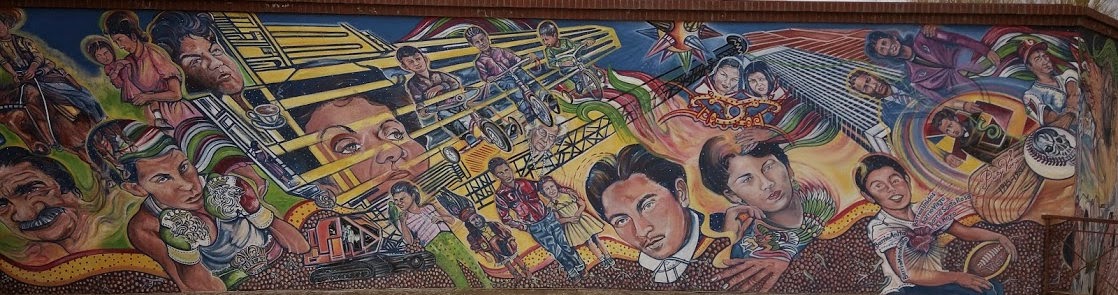
On another panel at the book fest, Peg Bowden, author of “Land of Hard Edges,” reminisced about growing up in the ethnically diverse, culturally rich Tucson. Later Peg told me that the ethnic breakdown was about 20% African American, 30% Latino, and 8% Asian. She heard Spanish and Mandarin spoken in the hallways of her high school. Mexican-Americans were active in politics and were revered. This got me thinking about my first impressions when I moved to Tucson. One of the first things I noticed was memorials with prayer candles and ribbons by the side of the road and altars to Our Lady of Guadalupe. I was struck by the incredible talent in the Latino community represented in art galleries, on murals, Borderland Theater Company, and Tucson Cine Mexico.


The first place we take out-of-town guests are our authentic Mexican restaurants such as El Minuto by the El Tiradito (the castaway) Wishing Shrine in Barrio Viejo. Then we head downtown to the restored Presidio near the Tucson Museum of Art to see the large Mexican nativity, El Nacimiento. The Mexican influence is evident in our cultural events. Tucson school children get two days off every year for rodeo days. 150,000 people gather for the annual rodeo parade to watch Vaqueros sitting high on their saddles, high school bands performing Mexican marches, and Mariachi dancers. 100,000 come out to experience the spectacular Dia de Los Muertos (The All Souls Procession). Mexican culture enriches our community. It is an integral part of our Tucson heritage. 

While researching Mexican culture in Tucson, I discovered that what had once been a thriving, vibrant community had been relegated to a museum exhibit. Before the urban renewal project of 1967 destroyed Tucson’s largest barrio, descendants of Tucson’s Mexican, Chinese and Jewish settlers still lived in their families’ traditional adobe row homes just outside of the Presidio walls. The Mexican barrios were tight-knit communities where family and church were valued. They gathered for holidays in the square. Everyone in the neighborhood knew each other and looked after each other. People shopped in neighborhood stores.  When Peg Bowden was at the U of A Nursing College, she did home visits on Convent and Canal Street. "People had chickens in the backyard and no electricity. They put their food on the back porch at night to keep it cool. They gave me warm tortillas fresh off the griddle when I visited. Great memories."

Politicians used the fact that some of the houses were ramshackle with backyard outhouses and that there was a rough neighborhood. They called the barrios a "blight" on the city. In the name of progress, the barrio was condemned to be replaced by a money-pit: a failed convention center and shopping center. This close knit community was torn apart, leaving some destitute. 

There are remnants of that vibrant barrio in what remains of the Historic Districts in Barrio Viejo including Teatro Carmen, the first venue in Tucson devoted to Spanish language productions and later used as a cinema, meeting hall, ballroom, and boxing arena. In Barrio El Hoyo there is a small garden and plaques that commemorate what used to be the Carrillo Gardens. The eight acres of garden boasted several small lakes and bathhouses fed by natural springs surrounded by cottonwood trees, fruit trees, and roses from around the world. There was a pavilion for music and dancing or skating. There was even a shooting gallery and a small zoo. Every weekend in the park was like a fiesta. 

When the barrio was gutted, Tucson lost much of its charm and history; in fact, its very heart and soul. In this time when politicians create an atmosphere of fear using undocumented workers as scapegoats, it’s important to remember those who built the adobe walls that became the Old Pueblo and their descendants who carry on our shared traditions.

Read more in my blog, "Footprints in the Dirt."